Hazen Research

  • HOME
  • ABOUT
    • MAP & DIRECTIONS
  • VALUES
  • CAPABILITIES
    • ANALYTICAL SERVICES
      • Water, Wastewater
      • Radiochemistry
      • Geologic Materials, Mill Processes
      • Precious Metals, Fire Assaying
      • Coal, Biomass
      • Sample Preparation
      • Quality Control
    • PROCESS MINERALOGY
      • QEMSCAN®
      • Optical Microscopy
      • Electron Microscopy
      • X-Ray Diffraction Analysis
    • MINERALS BENEFICIATION
      • Gravity Separation
      • Froth Flotation
      • Magnetic Separation
      • Other Beneficiation Methods
    • HYDROMETALLURGY
      • Leaching
        • High Pressure Leaching
      • Solid-Liquid Separation
      • Precipitation
      • Solvent Extraction
      • Adsorption and Ion Exchange
      • Electrochemistry
      • Crystallization
      • Pilot Plants
    • THERMAL PROCESSING
      • Drying, Calcination, Combustion, and Roasting Processes
      • Pyrometallurgy
      • Materials Processing
      • Process Development
      • Waste Treatment and Recycling
      • Analytical Capabilities
      • Equipment
    • ENVIRONMENTAL SERVICES
      • Waste Characterization
      • Hazardous Waste Treatability Studies
      • Quality Assurance and Quality Control
      • Health and Safety
      • Waste Characterization for Remediation Processes
      • Soil Washing Studies
    • ENERGY AND FUEL SERVICES
      • Fuels Characterization
      • Laboratory And Pilot Plant Services
      • Field Services
    • BIOTECHNOLOGY
      • Feedstock characterization
      • Biorefining
      • Laboratory and Pilot Plant Services
    • COMMINUTION
    • PILOT PLANT AND OTHER SERVICES
      • Pilot Plants
      • Engineering Services
      • Feasibility Studies
      • Field Services
  • CONTACT
  • JOBS
  • SITE MAP
  • ANALYTICAL SERVICES
  • PROCESS MINERALOGY
  • MINERALS BENEFICIATION
  • HYDROMETALLURGY
    • Leaching
      • High Pressure Leaching
    • Solid-Liquid Separation
    • Precipitation
    • Solvent Extraction
    • Adsorption and Ion Exchange
    • Electrochemistry
    • Crystallization
    • Pilot Plants
  • THERMAL PROCESSING
  • ENVIRONMENTAL SERVICES
  • ENERGY AND FUEL SERVICES
  • BIOTECHNOLOGY
  • COMMINUTION
  • PILOT PLANT AND OTHER SERVICES

HOME : CAPABILITIES : HYDROMETALLURGY : LEACHING

LEACHING

Leaching is the dissolution of metals or other compounds of interest from an ore or other solid into an appropriate solution. The solution is then separated from the insoluble waste (see Solid-Liquid Separation). The leaching process may employ one of a variety of chemicals such as dilute sulfuric acid, dilute aqueous cyanide, or other reagents. Methods for contacting ore and solution include agitating ground solids and solution (slurry) in open tanks, agitating slurry at a high temperature in a pressure vessel, or percolating solution through crushed ore that has been piled in a heap or vat and collecting the solution that issues from the bottom.

High-temperature and pressure leach processes are performed in autoclaves. Hazen's batch laboratory autoclaves and continuous pilot autoclaves have been operated under oxidizing, acidic, or alkaline conditions (see High Pressure Leaching). In other processes, oxidizing or reducing gases, such as air, oxygen, or sulfur dioxide, are used, taking into account the gas-liquid contact requirements.

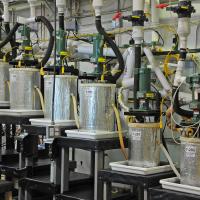
Some leaching systems are complex and are difficult to simulate in single-stage laboratory experiments. Such cases require special equipment and procedures to produce accurate data to predict how the system will perform in a large-scale commercial operation. For example, in the recovery of gold by cyanidation using the carbon-in-leach (CIL) process, the ground ore is suspended in a cyanide solution and is fed to a series of tanks. The slurry cascades from one agitated tank to the next, contacting activated carbon in each tank where the gold is adsorbed. Each overflow stream passes through a screened funnel into the subsequent vessel to collect the carbon from the stream. The collected carbon is manually transferred back to the preceding vessel (or other parts of the system) to realistically simulate the countercurrent flow of ore and carbon until the desired gold content is attained.

Leaching processes are also used to chemically remove contaminants from soils or other solids. Examples include removing mercury, organics, and other contaminants. Hazen has experience in a wide range of chemical soil washing (see Soil Washing under Environmental Services) projects for clients.

<< Previous: Hydrometallurgy

Next: High Pressure Leaching >>

Client Site Login

Questions, comments or requests? Contact us.
Copyright © 2012 Hazen Research, Inc. All rights reserved.